


Your shopping cart is empty!
Aster "Flirt"
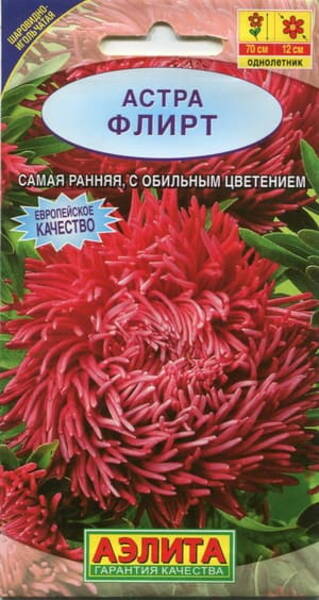
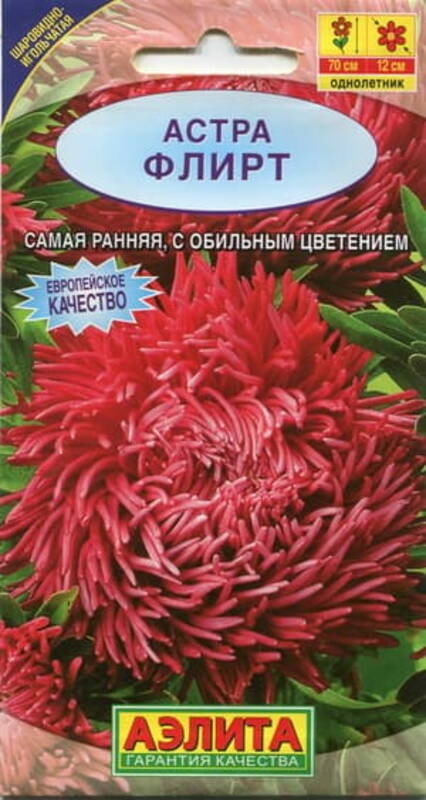
China Aster "Flirt" (Callistephus chinensis).
A pyramidal bush reaching 60 cm in height. Each plant produces 10-12 sturdy flower stalks. The inflorescence is large, densely double, with an elegant spherical-needle shape and a diameter exceeding 12 cm. The petals are slightly twisted, boasting a vibrant, bright red color. It is distinguished by its very early and incredibly abundant blooming.
Perfect for flower beds and cutting for bouquets. It grows equally well in open sunny areas and slightly shaded spots. The variety is highly resistant to fusarium wilt and other fungal diseases.
Growing conditions.
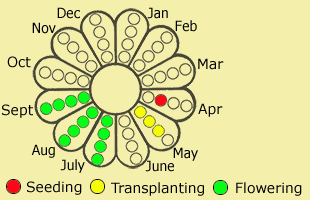
Sowing: late March to April for seedlings. Seedlings are planted out in May. Direct sowing outdoors is possible in late April to May under cover. Planting scheme: 30x35 cm.
Flowering: from July to September.
The annual China aster is a cold-resistant crop. Young seedlings can withstand brief temperature drops down to -3°C, and mature plants can endure up to -7°C. Botanically, it responds to day length: from the budding stage, it benefits from shorter days to initiate blooming faster, yet the growing area must still receive plenty of bright daylight, as asters require intense illumination.
A pyramidal bush reaching 60 cm in height. Each plant produces 10-12 sturdy flower stalks. The inflorescence is large, densely double, with an elegant spherical-needle shape and a diameter exceeding 12 cm. The petals are slightly twisted, boasting a vibrant, bright red color. It is distinguished by its very early and incredibly abundant blooming.
Perfect for flower beds and cutting for bouquets. It grows equally well in open sunny areas and slightly shaded spots. The variety is highly resistant to fusarium wilt and other fungal diseases.
Growing conditions.
Sowing: late March to April for seedlings. Seedlings are planted out in May. Direct sowing outdoors is possible in late April to May under cover. Planting scheme: 30x35 cm.
Flowering: from July to September.
The annual China aster is a cold-resistant crop. Young seedlings can withstand brief temperature drops down to -3°C, and mature plants can endure up to -7°C. Botanically, it responds to day length: from the budding stage, it benefits from shorter days to initiate blooming faster, yet the growing area must still receive plenty of bright daylight, as asters require intense illumination.
* Asters thrive in various cultivated soils but do best in light loamy and sandy-loam, fertile, well-drained soils with a neutral or slightly alkaline reaction (pH 6.5-7.5). On depleted, heavy soils, the plants lack energy: instead of lush, fully double flowers, they produce small, simple, semi-double flower heads.
Asters are highly susceptible to fungal diseases and can perish from fusarium wilt or botrytis, so you must never apply fresh organic manure to the soil before planting.
It is not recommended to grow asters in the same spot year after year. Return them to their previous bed no earlier than after 4 years.
Also, avoid planting asters after gladioli, tulips, or other crops prone to fusarium wilt.
Prepare the aster bed in advance. In autumn, dig deeply and incorporate high-quality humus or peat-manure compost at 2-4 kg/m2 along with 300 g of wood ash. In spring, just before sowing, add a complex mineral fertilizer.
Annual asters are propagated by seed. Sowing in open ground can be done at three different times. Autumn (winter sowing) is done in mid-November when cold weather has set in permanently. Sowing earlier than November is risky, as prematurely emerged seedlings will inevitably die in winter. You can also sow in winter (December-February) into frozen ground, but this is quite labor-intensive.
However, the most common method is sowing in early spring — in the first ten days of May, when the weather is warm and the soil has warmed up sufficiently but hasn't dried out. Aster seeds lose their viability relatively quickly, so it is best to use fresh seeds (from the previous year's harvest). Before sowing, it is recommended to treat them for 20 minutes in a weak potassium permanganate solution (1 g/L of water), rinse in clean water, dry slightly until free-flowing, and only then sow them about 2 cm deep in furrows, spaced 20-30 cm apart depending on the variety. Cover the seeds with a 1.5-2 cm layer of light soil and protect with horticultural fleece or film until emergence.
To prevent diseases, immediately after sowing, water the soil with a reliable fungicide solution.
To obtain truly strong and well-developed plants, seedlings must be thinned out: first at the 2-3 true leaf stage; secondly at the 4-5 leaf stage (leaving plants 10-15 cm apart, one per spot).
Asters respond very well to feeding. The first feeding is done a few days after thinning with a complex mineral fertilizer or nitrophoska (25-30 g per 10 L of water). During the budding period, asters particularly need phosphorus-potassium fertilizers (25-30 g per 1 m2). Mulching the soil with well-rotted compost (5-7 cm layer) before the bushes start actively branching is highly effective.
Asters love abundant watering. With a lack of moisture, the number of flowers drops sharply, and their decorative value declines. But remember: excessive moisture and waterlogging can trigger fusarium or "blackleg" disease.
The China aster blooms from early August right up to the frosts. To achieve earlier flowering (up to 2 weeks earlier), grow them from seedlings in greenhouses or on a windowsill. This also ensures the desired planting density outdoors and maximum decorative impact. A huge advantage of annual asters is their amazing ability to easily survive transplanting even during budding and early blooming, making them incredibly useful for quickly decorating flower beds, balconies, and outdoor planters. They are also excellent as cut flowers.
* The flower got its scientific name "star plant" (from Latin aster — star) perhaps because in autumn, when the beauty of most garden plants fades, asters continue to blaze with bright colors, surviving right up until the «first snowflakes fly», warming our hearts and souls with their late beauty...
There is also an old, romantic piece of folklore claiming that at night, asters whisper with the celestial bodies. And if you sit in a quiet corner of the garden on a clear night and listen closely, you might just hear the earthly «stars talking to the stars».